Motorola’s Razr Fold Is Now at Verizon. Just Don’t Pay Verizon’s Sticker Price
Verizon now sells the Razr Fold, Razr+ and Swarovski Razr with a free Moto Watch Ultra, but two of the three cost more than buying unlocked.

In this article
For a few years, Motorola phones had mostly vanished from Verizon’s shelves. As 9to5Google put it, “Verizon and Motorola have gone hand in hand for years, though Moto devices somewhat vanished from The Big Red in recent years.” That ended on September 24, when Verizon started selling Motorola’s full 2026 foldable lineup nationwide.
Three phones made the trip: the book-style Razr Fold, the Razr+ (2026) and a Razr (2026) with Crystals by Swarovski. Verizon is also carrying the Moto Watch Ultra and Moto Buds 2 Plus. The deals are aggressive. The prices, in two cases, are not.
Verizon vs. unlocked: what you’ll pay
| Phone | Verizon price | Unlocked price | Main display | Chip | Battery |
|---|---|---|---|---|---|
| Razr Fold | $1,949.99 | $1,899.99 | 8.1-inch OLED (6.6-inch cover) | Snapdragon 8 Gen 5 | 6,000mAh |
| Razr+ (2026) | $1,099.99 | $1,099.99 | 6.9-inch (4-inch cover) | Snapdragon 8s Gen 3 | 4,500mAh |
| Razr (2026) Swarovski | $999.99 | $899.99 (launch price) | Same as standard Razr (2026) | Same as standard Razr (2026) | 4,800mAh |
Android Authority caught the markup. The Razr Fold costs $50 more at Verizon than it does from Motorola, and the Swarovski Razr costs $100 more than its launch price. Only the Razr+ holds steady at $1,099.99. These are also Verizon-specific variants with their own model numbers, so they’re not identical to the unlocked phones.
The deals are where Verizon wins you back
Nobody pays retail on a carrier phone if they can help it, and Verizon’s offers are strong enough to flip the math for the right buyer:
- Up to $1,100 off select phones with an eligible trade-in for myPlan customers.
- A free Moto Watch Ultra ($349.99 retail) when you buy or bring a Motorola phone and add a new connected watch line. It comes as $350 in bill credits over 36 months.
- Monthly pricing on the Simplicity plan: $25 a month for the Razr Fold, $15 for the Razr+ and $10 for the Swarovski Razr, on 48-month terms.
- No activation or upgrade fees, plus six months of Google AI Pro for eligible customers.
Read the watch offer carefully. “Free” means a new watch line, which means a new monthly line charge on your bill. And the bill credits come over three years, so leaving Verizon early forfeits the rest.
Which Razr is worth it
The Razr Fold is Motorola’s first real shot at Samsung’s Galaxy Z Fold, and the specs back it up: an 8.1-inch inner screen, a usable 6.6-inch cover display, triple 50MP cameras, a Snapdragon 8 Gen 5 and a 6,000mAh battery. Verizon pitches it as “built for mobile productivity and heavy multitasking,” and on paper that holds.
The Razr+ (2026) is the easier recommendation for most people who want a flip. Its 4-inch cover screen does most day-to-day jobs without opening the phone, and it’s the one model where Verizon isn’t charging extra. The 4,500mAh battery is the smallest of the bunch, though.
The Swarovski Razr is a fashion piece: standard Razr hardware, a PANTONE Meteorite finish and a 32-facet crystal on the hinge. At $100 over its launch price, it’s hard to justify unless you really want the look.
The bottom line
If you’re already on Verizon and have a phone to trade in, this is a good time to get a Razr. Stacking up to $1,100 off with a free Wear OS watch is a strong deal. If you’re paying full price or you’d rather not lock in for three or four years, buy the Razr Fold or Swarovski Razr unlocked and keep the difference.
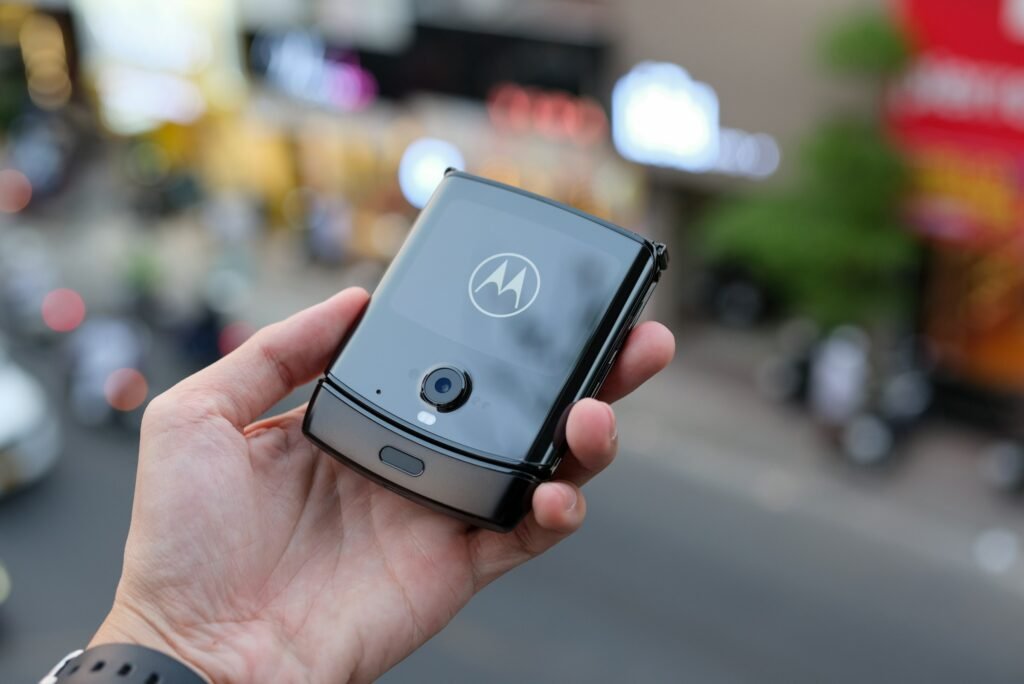
Sources: Verizon, Android Authority, 9to5Google. Photo by Thai Nguyen on Unsplash.

Harish
I am the founder of androidcaptain.com, a tech graduate and writes which covers android, smartphones, apps, software, and the rapidly evolving world of artificial intelligence. I focus on breaking down new technologies, exploring useful features, and helping readers understand how their devices and software can work better for them.